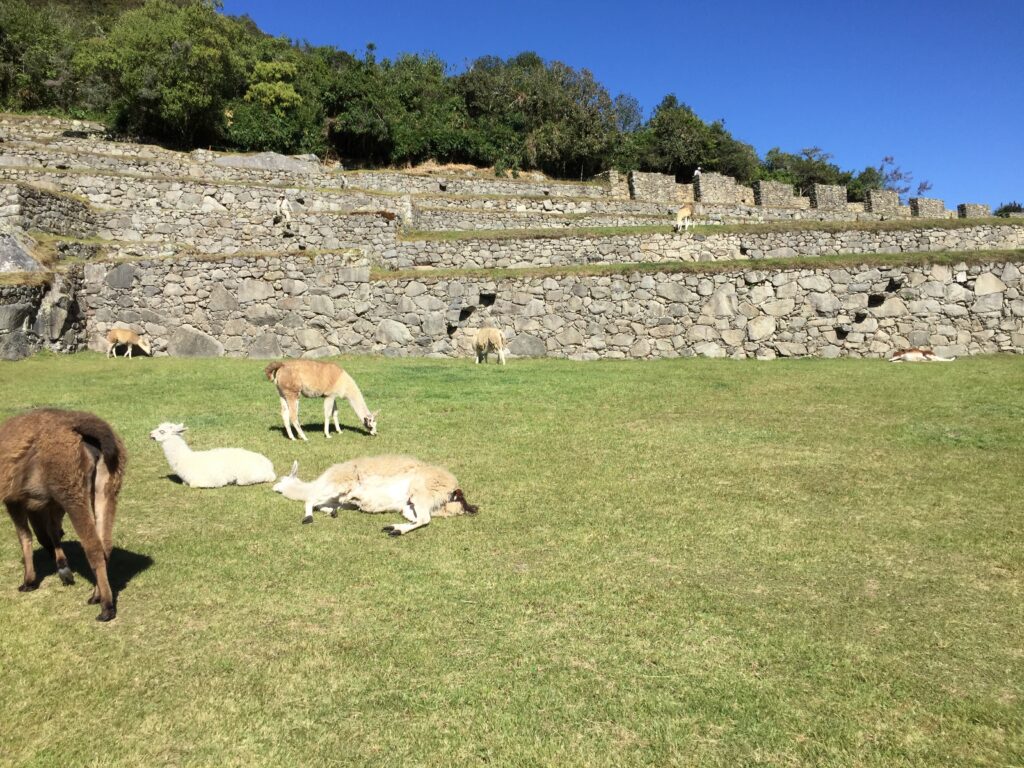
The Historic Sanctuary of Machu Picchu was established by the Peruvian government though a supreme decree, then a World Heritage Site through UNESCO. Machu Picchu is managed under the National System of Protected Natural Areas by the State (SINANPE). Machu Picchu is protected under Law 28296 which makes it a National Cultural Heritage site (Quechas Expiditions, 2025).
Machu Picchu is located in the Peruvian Andes and the Amazon Basin and sports many different types of ecosystems due to differing altitudes. At high altitudes it consists of a “Puna” grassland, Polylepis forests, and montane cloud forests. In lower altitudes in consists of tropical lowland forests (UNESCO, n.d.-b). Overall, the Historic Sanctuary of Machu Picchu has and incredible biodiversity and beautiful plants and animals. Machu Picchu is best known for its llamas who roam freely in Machu Picchu and are accustomed to tourists. Visitors can also have the rare opportunity to see the the only bear in Peru, the Spectacled Bear, who is considered endangered (Peru Jungle Trips, 2024). Machu Picchu is also considered to have 20% of the total diversity of plants of Peru (Ticket Machu Picchu, 2024a). With that being said, the are 17 species of flora that are critically endangered.
While Machu Picchu has many diverse ecosystems and landscapes, it is mainly a historical cultural resource. It has approximately 200 structures built by the Incas that make up the citadel. It is separated in multiple layers for farming and residential areas and has a complex irrigation system.
The Historical Sanctuary of Machu Picchu’s main (and pretty much only) activity is recreation. It is a sacred site and its rules and regulations are incredibly intensive. Hiking (on specific paths) and photography are the only things allowed in this area. Fishing, hunting, and extractive activities are not allowed. Visitors are not allowed to touch or climb on the walls of the structures. Visitors must not do activities that “distort the sacredness” of the site (Ministerio de Cultura, n.d.). Paragliding and operating drones is also prohibited.
Machu Picchu is a popular site with extreme altitudes which comes with many different threats to management of this protected area. The influx in visitor numbers can cause degradation of the environment, overcrowding, damage to structures, cultural issues, and increase of waste and trash. Climate change is also a significant issue for the management of this site. The high altitude and increasing temperatures lead to the acceleration of structural damage, habitats shifting altitudes, and ecosystem disruption (Machupicchu.org, 2025) While these issues may arise, the Peru government is doing an incredible job balancing both tourism and conservation.
