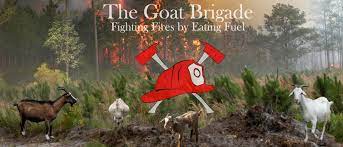
Executive Summary
As the population of the United States increases, more and more developments are being built further from urban centers which has heavily increased the wildland urban interface (WUI) around the country. The dense housing and commercial developments adjacent to the WUI makes them increasingly at risk of being damaged or destroyed in the case of a wildfire event. These large, often hilly areas make it difficult and expensive to manage vegetation in the WUI. Subsequently, this means that there are even more economic values and human assets at risk of a wildfire event. Furthermore, with the newest climate change projections there will be more erratic, unpredictable, and unnatural wildfire events in future years to come. The overarching response in the United States to the problem of an increasing number of fires and burned areas has generally been to strengthen fire suppression capacity.

Fast Facts
- The City of Laguna Beach found that goats cost approximately $500 an acre for vegetation removal as opposed to $28,000 for hand crews!
- Goats in a French study ate 2300 kilograms of edible dry matter per hectare out of the available 2900 kilograms.
- Goat grazing can be beneficial to habitat restoration efforts.
- Goats grazing mitigates herbicide and water run-off issues!
Presentation
Policy Brief
https://docs.google.com/document/d/1MYr3NMdZG_bD7lD54K3pLJxWjQNsMRtHKw-9TX4srxI/edit?usp=sharing
