
My Rankings: As a potential HR professional, I came up with my list of benefits packages by ranking those benefits from the most likely to the least likely: 1. Flexible spending accounts (FSAs) will privilege me to pay for certain benefits expenses (health care or child care) with pretax dollars. 2. I also prefer The Family and Medical Leave Act of 1993 (FMLA) as it will provide me with job protection in cases of family or medical emergencies because my parents have been living with me and they are becoming elderly, rendering them susceptible to a serious illness or medical condition. So, they require frequent attention for an extended period while ill. 3. Moreover, I consider Daycare as another potential benefit for me. I will prefer to work with a company where they have Child care programs that offer supervision, preschool preparation, and meals as I am planning to have kids in near future. 4. Additionally, I valued the paid time off it will contribute to my commitment to the company that I will work for, particularly if I am hoping for being there for a long period of time. 5. Profit-sharing plan will assist me to build toward a comfortable retirement, and also make me feel that I will be working as part of a team helping the company achieve its goals.
Revised Rankings: When I research more regarding discretionary benefits, I find out it is crucial for a company to weigh the cost against the benefits, and a generous benefits package is essential for attracting and retaining top talent.
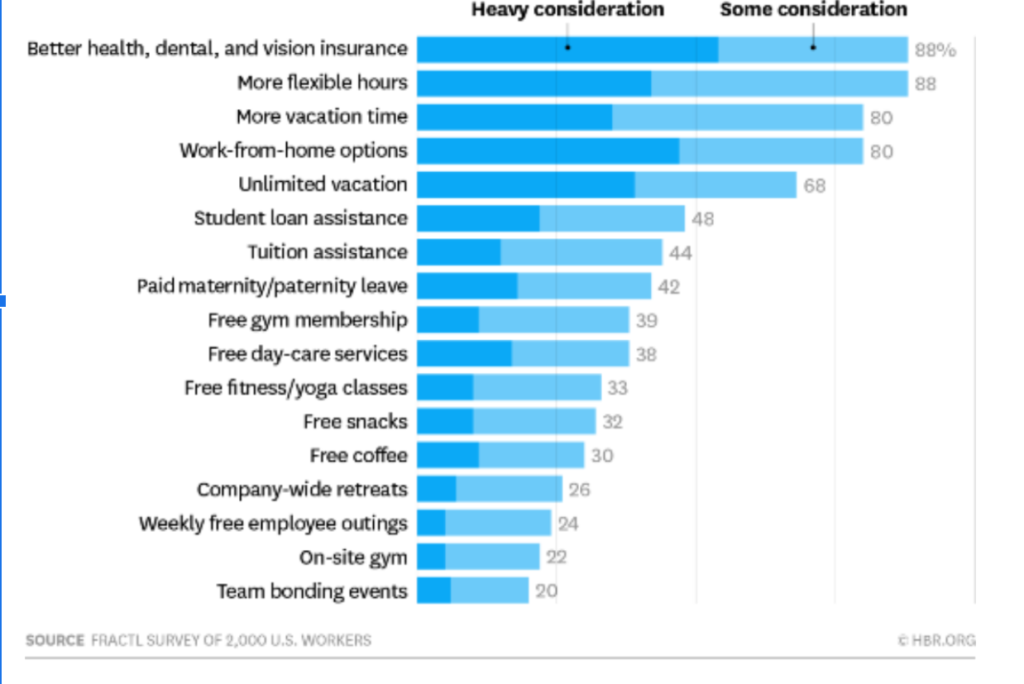
- Health insurance is the most pricey benefit to provide but it covers the costs of a variety of services that promote sound physical and mental health which includes physical examinations, diagnostic testing, surgery, hospitalization, psychotherapy, dental treatments, and corrective prescription lenses for vision deficiencies.
- Employees also place the highest value on Flexible scheduling and leave benefits that are relatively low-cost to employers, such as flexible hours (e.g., 10-hour days or 12-hour days), job sharing, paid vacation time, and work-from-home options as those help employees balance the demands of work and family. most of the employees responded they would consider a lower-paying job with unlimited vacation, and those relaxations boosted their productivity.
- Pay for knowledge, Tuition-reimbursement program also ranked highly on the list of coveted benefits, from SHRM findings, it can be said that if companies offer student loan assistance, and graduate educational assistance, then they can motivate employees to complete courses within the curricula and the company can take advantage of a tax break.
- Women were more likely to prefer Family assistance programs benefits like paid parental leave and free daycare services. Parental leave is of elevated value to female employees as most of the women said they’d give parental leave significant consideration when choosing a job and they prefer ‘Child Care Programs’ because they may have preschool-age dependent children whose parents work outside the home.
- Moreover, companies can offer employees welfare benefits to promote good management and enhance worker productivity. Likewise, those programs treasure team-building events, retreats, free food, free fitness programs.
Works Cited:
- Jones, K. (2017) The Most Desirable Employee Benefits, Harvard Business Review Digital Access. April 15, 2017, 2-6.
- Markovska, M. (2018) Career Minds. The Biggest Trends We Will See in Discretionary Benefits in 2018.
- Martocchio, J. J. (2018) Strategic Compensation. A Human Resource Management Approach 10th ed.
