
Josh Fiedler, 10/14/2021
I recently went back to play Minecraft after several years of hiatus, and fell into a rabbit hole exploring the many mods that have evolved around this game. ‘Mod’ = modification, meaning players and fans of the game create their own features or assets and implement them into the game. Modding has become a popular hobby with entire communities sprouting up around games that support such capabilities, like Minecraft, The Elder Scrolls: Skyrim, and others. The answer I want to know: does modding act as an effective introduction to those who are interested in learning programming?
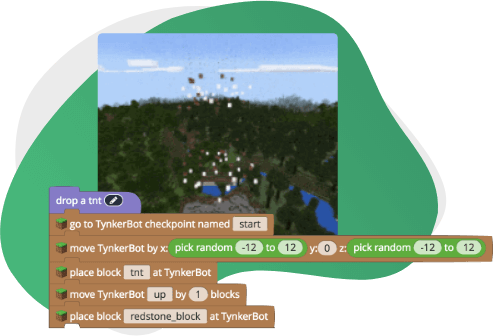
Minecraft’s simple game concept attracts equally simple modding tools. One program, Tynker, provides a user friendly code-block style programming tool that allows for easy and simple scripts:
As Minecraft is written in Java, modifications can also be created using pure Java code. This affords an opportunity to use real world tools like the Eclipse IDE to learn programming in Java while creating Minecraft mods. One such guide is the The Ultimate Guide to Minecraft Modding with Java in 2021.
Along with hobbyist programming, video game mods can open more substantial doors, from job opportunities to completely new standalone games. The title I am talking about is Counter Strike, a popular competitive shooter game that evolved from Valve’s game Half Life, which supported modding features for its in-game maps. According to Redbull.com, “The developers, Minh Le and Jess Cliffe, created the map through the GoldSrc engine and it is estimated that it took them one and a half month of programming for the first beta to be completed… Eventually, in 2000, and after the release of the fifth beta, video game developer Valve caught their eye and wanted to hire Le and Cliffe. Valve saw the potential in the mod and wanted Le and Cliffe to continue their work. Said and done, Valve bought the intellectual property of Counter-Strike and released, together with Le and Cliffe, the first non-beta version in September 2000 on PC.” To me, this success story sounds like a dream scenario: 1.5 months of work to get one of the most popular competitive video games off the ground, hired by a major game company who buys your creation in the process. Sounds lovely.
I see modding as an environment where programming fundamentals can be learned purely from the perspective of a hobby, but taken as far as the career level if one is determined to do so. Where school assignments sometimes fall short in awakening a person’s creativity, mods allow eager programming hobbyists to learn new technology while contributing to something they enjoy in a fun way.
