
Josh Fiedler, 10/7/2021
Today I thought about the ways in which software is made more accessible, and decided to write my blog post about a few ways that I take advantage of accessibility features. I then compare two dark mode extensions to see which one delivers the desired outcome better.
Video games are one of the many platforms where software is used by millions of, well, users. In competitive games, team play is usually enhanced with color codes – but this alone does not always aid the player. I am red/green color blind and sometimes it is difficult to differentiate teams, since the common team-based red/blue color scheme is often toned down with orange/green hues. However, I have noticed that several games feature color blind user interface settings. These usually tweak the color scheme by converting all necessary team colors to more bold, contrasting colors. Its a small software feature, but offering that customization has a major impact in enhancing the player experience while keeping the perceived color-blind disability discrete (since other players will see their own color scheme settings). Examples of such games include Splitgate and Black Ops Cold War, seen below:


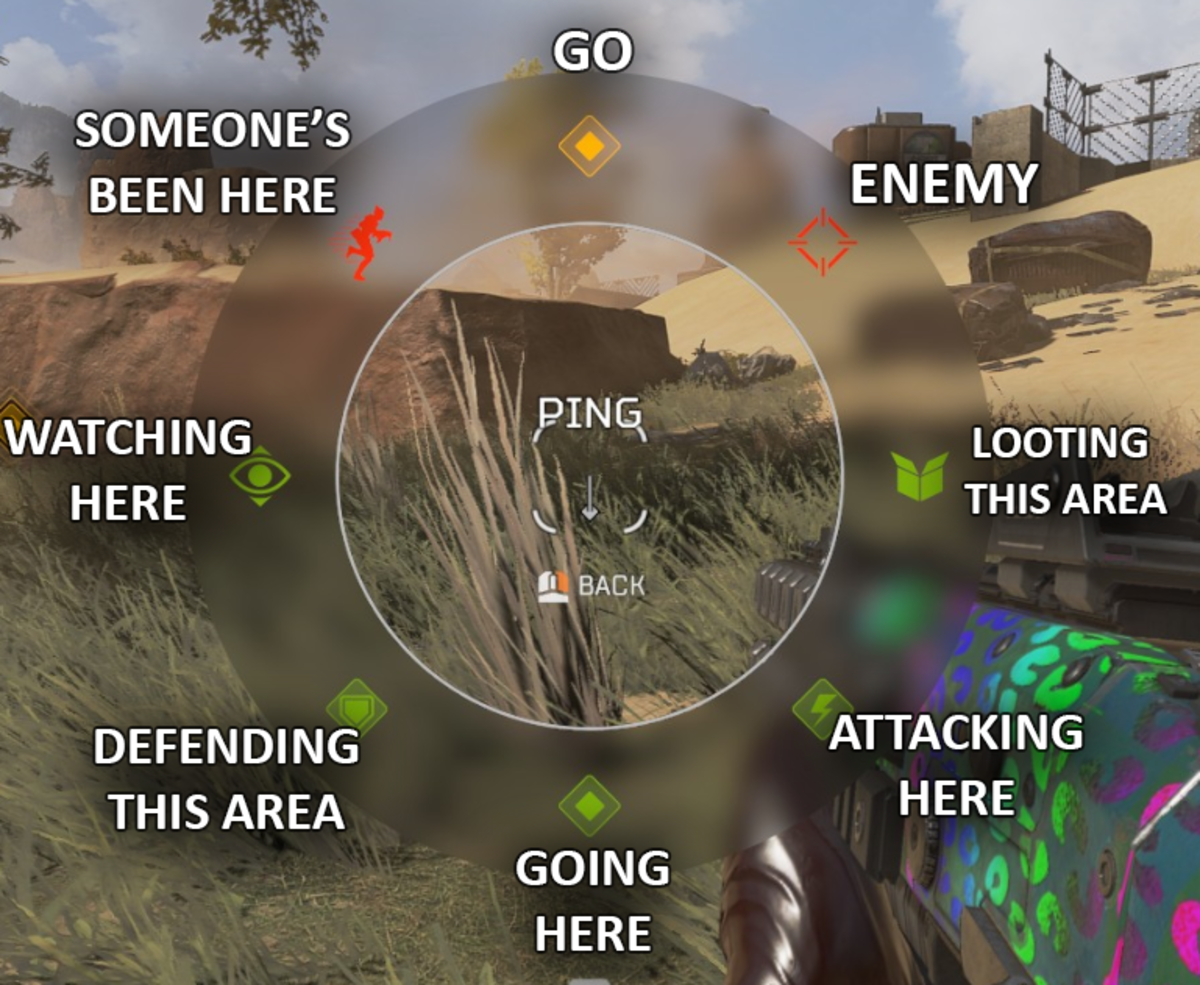
Another interesting accessibility feature that I take advantage of is also present in video games: the ability to communicate without the use of voice features. Even if a player is fully capable of voice communication, there is a case for not wanting to face any insecurity or judgement based on voice tone, which can reveal subtle personal clues like age or gender. In competitive games, this helps when you might be randomly matched with a toxic player. Or, sometimes you are playing a team based game but none of your teammates are using microphones to chat. Fair enough, because there is a growing trend of non-verbal ping based communication in online games. A ping is basically a visual marker that players use to relay pre-defined messages to others. I personally love this feature because I am an introvert, and usually prefer pings like this over talking to strangers. However, when I get really competitive and choose to use voice chat, the ping feature serves to almost highlight how desperate I am for my teammates to understand my wisdom and skill… Anyway, here is a screenshot of one such ping-based system in Apex Legends:
I think one of the most common (or popular) accessibility features in software is dark mode. Is this really an accessibility feature? I think that is up for debate. However, I did meet a guy (through voice chat in Apex Legends… is this all connected?) who said that he cannot use the internet without dark mode, to the point where he used a special Google Chrome extension. I recently (~ 5 minutes from starting this blog post) found an extension that does what he described, by replacing all web pages’ white backgrounds with a dark gray tone. However, I ran into a few issues.
The feature is a little buggy; as it is not an official Google product, there are a few instances where the behavior does not deliver what is expected like in this Google search result:

The extension is called Dark Theme For Chrome and it has 4.2 out of 5 stars (522 reviews). For full disclosure, I discovered a better extension that does the same task only after seeing Dark Theme For Chrome. Yes, Super Dark Mode (emphasis added) performs the same accessibility overhaul of Chrome but in a much better way. See the proper performance of the same task from before:
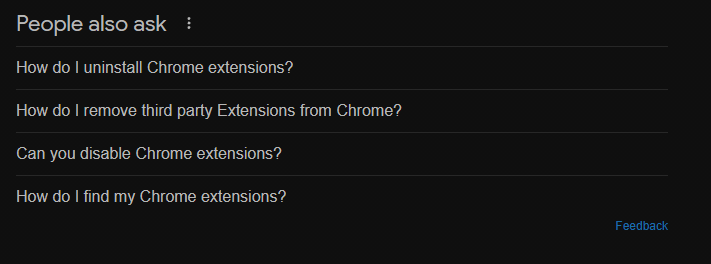
Super Dark Mode has 4.7 out of 5 stars, with 4,678 reviews. Interestingly enough, Dark Theme For Chrome had 500,000+ users, while Super Dark Mode had 100,000+ users. It seems to me that Super Dark Mode has the more loyal fanbase, since I can reasonably estimate that 4,678 users per 100k users reviewed the extension versus ~104 reviews per 100k users on Dark Theme For Chrome.

In conclusion, accessibility features transform our interaction with software and are growing in popularity. Since many of these features are recent developments, accessibility is an interesting segment of the software world to watch in the future.
