Categories
Uncategorized

Training Experience

Cameron Sandmire

When I first started my internship, we met on Zoom twice a week to learn new sales techniques. For the most part, I enjoyed these sales calls and got a lot out of them, but one stood out as particularly bad. The best way to break down why is to use “Kirpatrick’s Levels” from our lectures. 

To preface, we had a guest speaker for the sales interns that week, and she said a couple of things that didn’t feel moral or right. We were selling products in the store, and she urged interns to tell customers that promotions were ending much sooner than they were to promote urgency, upsell to customers even if they don’t need it, and make up stories about past customers who bought and loved the product. Level 1 of Kirpatrick’s Levels is Reaction, and I can confidently say that nobody reacted positively to this advice; we were all pretty shocked. Level 2 is Learning, and I would say we learned nothing that we actually wanted to use. Level Three is Behavior. I don’t want to speak for my fellow interns at the time, but I didn’t make any changes to my sales behavior due to that meeting. If anything, it made me put an emphasis on fitting people into what is right for them. Level 4 is results, and no, it didn’t have a positive or negative effect on our results. They stayed trending the way they were before, and everyone ended up joking about that meeting weeks later. 

An experience that I had that checked all these boxes was at a southern division retreat for the same company when I was a hired employee after the internship. That week, we were able to get our hands on the tools we were selling in the aisle. Each station ran us through how to use the tool with demos and ten minutes of information about the tool that we could use to sell it. This was the most tangible training we had so far and left me with real information that I could confidently use to boost my sales numbers. For months after, I was thinking about what I had learned from that experience, and it genuinely changed my sales behavior. 

Overall, the experience you have with training, even within the same company, can vastly change your ability, experience, and confidence.

Sources:

Lecture 2

Categories
Uncategorized

Implicit Bias- Disability

Cameron Sandmire

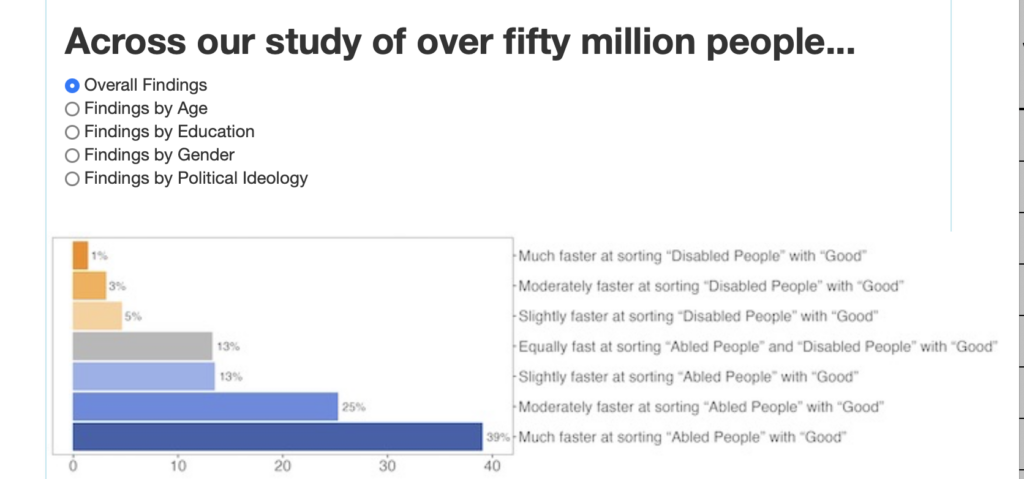
Out of the list of tests provided, I decided to test my bias on disability. The reason I chose this is because I have been taught to feel empathy toward disabled people and I wanted to see if that held up. The test was difficult and challenged not my beliefs, but how quickly I was able to respond to associations between good, bad, disabled, and abled. Although I felt like my brain had melted by the end of the test, I learned a lot.

The results I got indicated a moderate automatic preference towards abled people over physically disabled people. This shocked me for a lot of reasons, especially because I would never guess that I have an implicit bias towards that specific group of people. In the article “How to Think about Implicit Bias” they say “Most measures in psychology, from aptitude tests to personality scales, are useful for predicting how groups will respond on average, not forecasting how particular individuals will behave.” This resonated with me because I do not believe that an unconscious bias would determine action or treatment in an unfavorable manor towards a disabled person. By this I mean that I always try to treat disabled people as kindly as possible without being offensively kind because life is harder for them and I want no part in making it even harder. Where the bias comes in is that initial feeling long before you act, but who you are is determined by what happens in-between that underlying initial bias and action. I think to counteract any implicit bias one has you must be patient enough to analyze the person and situation before speaking or acting.

Sources:

Payne, K., Niemi, L., & Doris, J. M. (2018, March 27). How to think about implicit bias. Scientific Americanhttps://www.scientificamerican.com/article/how-to-think-about-implicit-bias/

Be Better Blog. (2021). Understanding implicit bias — and how to work through it. bhgrecareer.com. https://bhgrecareer.com/bebetterblog/implicit-bias/

Categories
Uncategorized

What Interviews Taught Me About the People Doing the Hiring

I used to feel nervous going into interviews until I realized that the employer is being evaluated too. Nothing made that clearer than my first job at a Hawaiian grill near my parents house. There was no interview. I showed up, signed a w2 and I9, before I knew it I was cooking over a 500 degree grill with no AC in the middle of summer. This interview had no fixed set of questions and no systematic scoring procedures making it an unstructured interview(lecture 3). 

My next experience was the complete opposite. I interviewed at a local golf club and was asked tangible, job relevant questions that clearly tied in to the actual responsibilities of the role. It felt like they knew exactly what they were looking for which is a key difference between an interview that’s grounded in job analysis and one that isn’t. Questions tied to real job tasks give you real information about a candidate, which is exactly why that interview felt different from the start as mentioned in lecture two of the week 5 course materials.

Then came my first corporate interviews. Four rounds of interviews, three months of waiting, and questions like Four interview rounds, three months of waiting, and questions like “Can you walk me through a time when you had to navigate a complex interpersonal dynamic within a team setting?” Chamorro-Premuzic and Steinmetz (2013) warn that free-form interviews “can easily feed false perceptions” structured interviews where every applicant answers the same questions produce much more consistent results. This company, although I liked the job, was four rounds of corporate jargon and I still couldn’t really tell you what they were looking for. The actual job was great but the amount of fluffed up emails I had to write that sounded just like the interviews was telling.

What I’d tell each of these employers is the golf club had it right. Build your questions from job analysis, standardize the process, and decide what kind of answers you want. How a company interviews candidates is a direct preview of its operation.

Sources:

Chamorro-Premuzic, T., & Steinmetz, C. (2013). The perfect hire. Scientific American Mind, 24(3), 42–47.

Buckingham, M., & Coffman, C. (2016). First, break all the rules: What the world’s greatest managers do differently.Gallup Press.

Categories
Uncategorized

BlogPostCameronS

After reviewing the Fortune 100 list of best companies to work for I decided to pick three companies that offer entirely different services and see what they have in common that lands them on this list. They all operate under different business models, have different customers, and yet they still found their way here. In our learnings we discovered that there is no one type of culture that leads to a positive company culture and, in my mind, these three prove that to be true.

Zillow is a strong example of positive company culture. 95% of their employees report that they are proud to work at Zillow, 94% report that they believe their management to be honest, trustworthy, and ethical, and 92% report that it is an overall good work environment. One of the driving factors is their “Cloud HQ” remote model. Since they adopted this strategic HR strategy they have had no drop in productivity and the team is moving faster than ever on platform development. Zillow employees also note perks such as maternity leave and contributions to medical deductibles.

Delta takes a different approach to the same care for their employees. Instead of focusing on perks they give employees direct share in the company. Employees enjoy a 10% share in Delta’s first 2.5B in revenue during the calendar year and an additional 20% of any profits after that. In 2025 employees were payed out just over 1.3B from deltas revenue. This as well as strong management structure and strong HR presence has lead nine out of 10 Delta employees to reporting that they would like to work for the company long term.

Skripps Health has a mix of each of these approaches. They invest over 13.5 million back into the development of their employees. This often times comes in the form of career advancement or transition programs that keep employees from feeling stagnant. They currently have nine different programs in place and this likely relates to the fact that 94% of their staff feel like they are able to make a difference and 94% feel great about Skripps role is serving it’s employees and the community around them.

Across these three companies, employees are engaged, stay longer, and perform better. This leads to the best possible customer service and strongest business outcomes.  This directly shows the data driven business decisions the “New HR,” that Breitfelder and Dowling talk about, make and how important they are within their respective organizations.